STORYBOOKS FOR CHILDREN

STORYBOOKS FOR CHILDREN
Give a Book as a Gift
Showing posts with label Kedah. Show all posts

15 Jul 2017

Mukim Council


1. A newspaper report in the Straits Times, 19 August 1948, on page 7 carried the headline “Mukim Councils to Aid Defense, Urge.” The first paragraph read:
"A Malay Unofficial Member, Mr. M. I. Merican, urged today the appointment of Mukim Councils to aid in Kedah’s defence organization during the “present emergency.”
2. An incident in June 1948 triggered the “emergency” when three European plantation managers were killed in Perak. In response to the incident, the British brought emergency measures into law, banning the Malayan Communist Party (MCP) and other leftist parties. Consequently the military arm of the MCP began a guerrilla campaign which marked the beginning of an armed insurgency.
3. In the news quoted above, the paper was reporting on an adjournment speech delivered by M. I. Merican at the meeting of the Council of State held on 18th August, 1948. He was appointed an unofficial member of Kedah State Council and Council of State on 1st February 1948 and served until 1955.
4. In his speech, he told the Kedah State Council that the setting up of Mukim* Council “would require legislation to empower such Council to carry on its functions and duties.” He stated that “the Council would appoint its own Chairman and members,” pointing out that “all the natives of the Mukim would be eligible for membership of the Mukim Council irrespective of race, religion and creed, which would foster inter-communal amity.”
5. With regard to defence he stated that “the Council would create and form kampong volunteers for the safeguarding of the Kampong.” He pointed out that “there could be night patrols of Kampong Volunteers who could arrest undesirable persons and hand them over to the Police.”
6. At that time talk of self-government was the order of the day. In his speech, M. I. Merican cited that “His Highness the Sultan declares in the Laws of the Constitution of the State that election will be introduced in due course.” He pointed out that election “would be the beginning of self-government whenever it should happen.” He reasoned that “The Mukim Council when and if in existence would be a good training ground for the principles of the election as a step forward to local self-government.”
7. His view of the Mukim Council as “a step forward to local self-government.” is clearly defined in the following statement:
“Now all the functions and duties of the Mukim Council aim at their realisation of local self-government. This self-government is a small pattern of democracy which is the ultimate objective of the declaration of His Highness the Sultan to introduce election in due course. By training themselves in the principles of local self-government the inhabitants of each Mukim will unconsciously prepare themselves for the eventuality that will emerge to confer self-government on the peoples of the Federation of Malaya.”
8. Further, M. I. Merican pointed out that the benefits that would accrue to the Mukim would be great in relation to economic and industrial matters. He stated that “The Mukim Council would have a wide scope of work affecting beneficially the welfare of the inhabitants of the Mukim” which would include pasturage, sanitation and health, co-operative padi planting and other industrial pursuits.
9. Regarding pasturage, he stated that “the Council could apply for State Land to serve as grazing grounds for their cattle.” He said that the grazing grounds “would eliminate prosecutions for animal trespass on bendang land – a common type of offence in the Mukim.”
10. With regard to sanitation and health, he stated that “the Council would be able to call on the kampong people to clear away the dirt and keep their kampong clean and to see to the instituting of safeguards against the pollution of wells and streams which form the source of their water supply.” He also pointed out that “drainage on a small scale could be taken in hand to clear away stagnant water and thus abolish breeding places for mosquitoes.”
11. Further, he stated that “the Council would encourage co-operative activities in padi-planting and other industrial pursuits such as weekly fairs and the production of other food crops.”
12. In conclusion, he stated that “the Department of Public Relations which has done so much good to the inhabitants of the rural areas in interpreting Government policy and imparting useful information,” could play an important role in assisting “the Mukim Councils as the medium of their exchange of ideas for the good of the country as a whole.”

*Several “mukims” make up a district called “daerah.”
bendang = paddy field
padi = rice

Group photograph of members of the Council of State during the second meeting of the Council on 11th April 1948. [Enlarged image: M. I. Merican]


15 May 2017

A Change of Heart


1. The last Malaysia’s general election was held on Sunday, May 5 2013. It was regarded as a stiff fight between Barisan Nasional (BN), the ruling party, and Pakatan Rakyat (PR), an informal coalition of opposition parties.
2. My wife and I cast our votes in Alor Setar, my hometown, which is about 60 kilometres from Sungai Petani where we live after I retired as a government servant in 2003. It was already past 6.00pm when we were on our way home. There are at least half a dozen small towns along the main road from Alor Setar to Sungai Petani.
3. We had to go slow every time we approached a small town because of traffic congestion. Excited and rowdy PR supporters predominantly from PAS and PKR were jamming the road in their cars and MPVs as well as on their motorcycles.
4. Many passing motorists honked as a show of support. Chinese shopkeepers and tradesmen were out in front of their shops cheering and waving hands at the passing procession.
5. The jubilant supporters were apparently satisfied with the turn out of their voters at the polls. They seemed very confident that PR would defeat BN and take over the federal government at long last. Being BN supporters, we were very annoyed to witness the rejoicing on the road every time we passed a town.
6. Kedah state was then under the rule of a PR government headed by PAS. We were hoping that BN would win back Kedah in the election, but our hopes dimmed as we watched the rejoicing PR supporters seemingly celebrating an anticipated victory.
7. It was a real eye-opener for us. Indeed, we had not expected such a strong support for the opposition. We realized then that we knew almost nothing of what was happening at the grass roots. For news and information, we relied solely on the mainstream media which accommodated our trust in BN-led government. And we had always stayed away from political rallies.
8. That night, we stayed awake to watch the election results closely on TV. It was rather upsetting to learn that the opposition candidates were winning parliamentary and state seats by leaps and bounds. But to our relief, BN won the election albeit with reduced majority. PR won 51 percent of the popular votes. And much to our surprise, BN won back Kedah.
9. The MCA and Gerakan, BN component parties, lost heavily in the election. The incumbent prime minister was evidently disappointed with ethnic Chinese voters of both parties for giving their votes to the opposition parties. He called it the “Chinese tsunami”.
10. The aftermath of the election was just as dramatic. On May 8, 2013 PR held a rally at Kelana Jaya Stadium in protest against alleged fraud and other voting irregularities committed by BN and its supporters. This was followed by similar rallies across the country.
11. Even then we did not realize that the mainstream media, which were pro-government, had understated the full scale of the protest. Reports seemed to give the impression that the protest was a nuisance to the public. So we thought then that the opposition should concede that they had lost the election.
12. It took us another couple of years to realize that our trust had been betrayed by the BN-led government. It was humiliating to learn that those people rejoicing on the road on the evening of the last general election were far ahead of us in their awareness of the political and economic situation in our country.
13. In the months that followed after the election and in the ensuing couple of years, unpleasant rumours were flying about the shortcomings of the head of government and the intrigues of his spouse. One such gossip was the couple’s extravagance. At first we thought that those were only unsubstantiated rumours. But then ‘there’s no smoke without fire.’
14. Then there were allegations of bad governance, government policies that are damaging to the country, abuse of power and corruption involving the head of government. You might not find these being reported in the mainstream media. They emerged in social media.
15. Then came the GST which was implemented on 1 April 2015. The ordinary people were hit hardest by this legislation. They have to pay an extra 6% of the amount of money they spend at a restaurant or a supermarket.
16. By 2016 the 1MDB scandal had become known to the people although the mainstream media reports downplayed the gravity of the issue. We no longer read pro-government newspapers. My wife being a newspaper-lover had found a new favourite which seems to convey impartial reports.
17. We are disillusioned with the dominant political party which leads BN. We believe that its present leadership and his supporters have deviated from its noble cause.
18. The party has a history of “money politics” in its leadership elections. Potential candidates vying for posts in the party were known to have used wrongful means to win contests. These include using a lot of money to bribe the delegates in order to vote for them.
19. Winning a party post is a stepping stone to hold the reins of power. When you are in power you can make a lot of money and get rich.
20. The next general election is just around the corner. It is not going to be an easy task for the opposition to defeat the BN in the coming election. To form a solid coalition of the opposition parties is easier said than done. A one-to-one electoral contest would give the opposition a fair chance, but there might be third parties which could put the opposition at a disadvantage.
21. The question is, can the opposition gain the people’s confidence? If they were to take over Putrajaya, can they govern the country any better? Is there any guarantee that they would strive to project a clean image?  
21. The present head of government is going all out in his bid to win the coming election. Unless there is a surge in support for the opposition, it is quite impossible to topple the ruling government.


PAS = Pan-Malaysian Islamic Party
PKR = Parti Keadilan Rakyat (People’s Justice Party)
MCA = Malaysian Chinese Association
Gerakan = Parti Gerakan Rakyat Malaysia (Malaysian People’s Movement Party)

23 May 2013

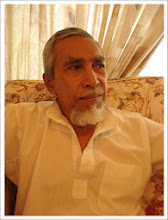
My father


In his own handwriting, my father wrote his name as “Md. Ismail Merican”. His first marriage was to one Che Chik binti Hassan who passed away following an illness. I’m not sure whether he had any other marriage(s) before he got married to my mother, Che Gayah binti Abdul Rahman. I was born in 1947, so they might have got married in 1946 or earlier. Their other children are my younger siblings: Mohd Hussin Marikan and Che Aminah. My father had no children from his previous marriage(s).
   My father passed away in 1957 when I was 10 years old. He left us no fortune (except for a few ringgit in his savings account) which definitely broke my mother’s heart. However the poor woman managed to raise the three of us through hardship and saw us through our schooling until we are able to find decent jobs. 

   After my father’s death, family connection with his side of the family had broken off completely. My mother was quite indifferent when I asked her about my father. So what memories I have about my father are childhood memories – a tired old man sitting in his armchair smoking his cigar, or taking his usual strides across the hall after lunch or dinner, or being massaged nightly by his wife in bed. His large portrait in official uniform hung on the wall.

   As I grew older (after his death) I began to realize that my father was “somebody” in the state. I heard elderly kampong folks said: “dia yang buat undang-undang negeri Kedah” (he was the one who made the laws of the state). Even at that time I knew that their notion was misleading. Then I read from somewhere that he used to serve as superintendant of education and legal adviser. It seemed that he was also one of the earliest headmaster of the first English school ever established in Alor Star.
   Only lately, after my own children showed a keen interest to investigate about their grandfather, we began to spend time in the archives to dig out some facts. Thanks to the archives clerks, we were able to access several documents which contain records about the old man’s career in Kedah.

   Md. Ismail Merican came over from Penang and started his career in KCS as the headmaster of Government English School in 1911. For some time he was senior auditor (1913-1915). He was a high court registrar (1917-1922), and served in the office of legal adviser (1922-?). He retired in 1937, after which he served as an unofficial member in the State Executive Council and State Council (1947-1954).

To be continued...